


Fluvsies Care: Princess
TutoTOONS
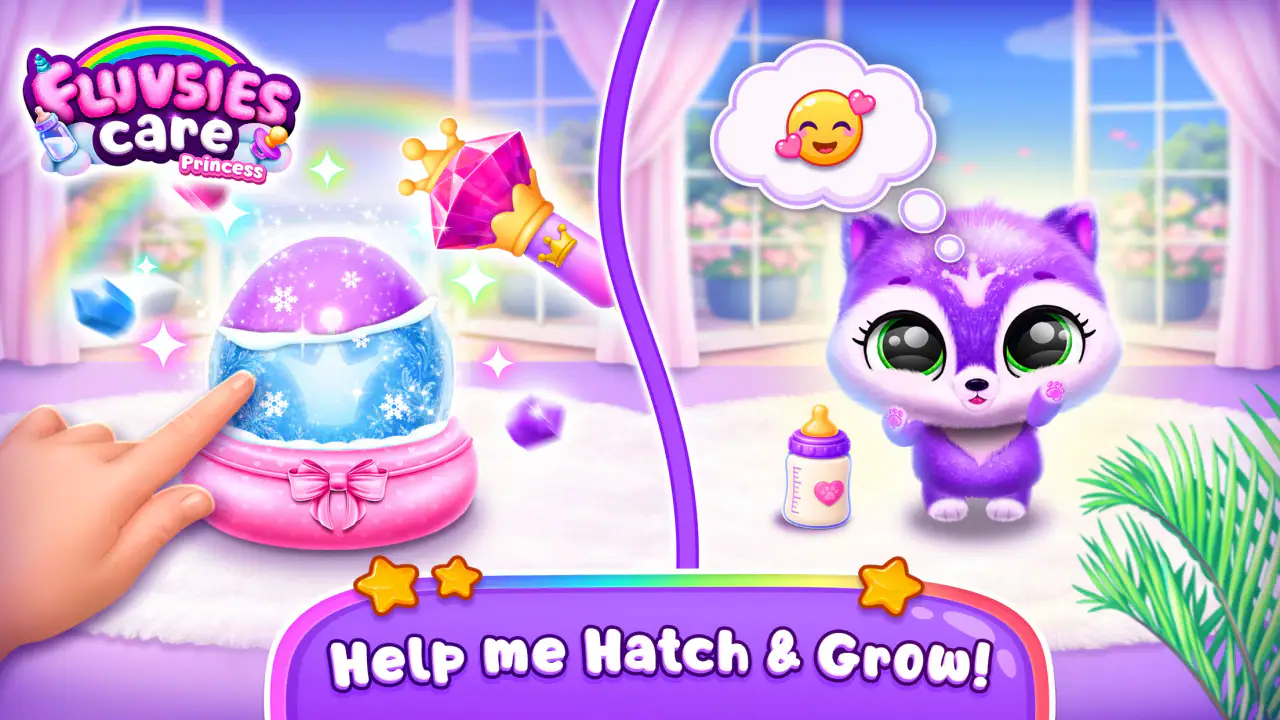
When I tried Fluvsies Care: Princess, I quickly understood that its appeal is less about winning and more about creating a small care routine around a fluffy virtual pet. The game lets you hatch, feed, and look after a cute companion, with a princess theme that gives the experience a gentle, playful identity. I can imagine it working especially well on a shared family tablet, where a child can check on the pet while an adult helps with the parts that require patience or spending decisions.
This is an educational game from TutoTOONS, although I would describe its learning value as informal rather than classroom-style. It encourages attention, sequencing, responsibility, and basic decision-making through repeated care tasks. It is free to start, rated for Everyone, and has reached over one hundred thousand installs. Its average rating is 4.2 from roughly two hundred ratings, which suggests a generally positive reception without making it a universal recommendation.
How Fluvsies Care: Princess Works in a Shared Household
The best way to approach this game is as a short, repeatable activity rather than something a child should play continuously for a long stretch. A child might open it after breakfast, tend to the pet, and return later when there is another reason to interact. On a shared device, that rhythm can be useful because the game does not need to dominate the household schedule to feel rewarding.
I found the pet-care idea more suitable for cooperative use than many competitive children’s games. One person can choose what to do next while another watches, suggests an action, or helps interpret what the pet needs. That makes it a reasonable option for a younger child who is still learning how to follow a sequence. The adult does not need to turn every session into a lesson; simply asking, “What should we do first?” can make the routine more interactive.
There is also a practical advantage to the slower pace. If two children share one tablet, they can take turns with clearly separated sessions instead of arguing over a competitive score. I would still establish the turn length myself, because a virtual pet can make a child want to keep checking for the next activity. The game’s gentle tone helps, but it does not replace household rules about when the device is available.
Related News






A useful routine is to let one child handle feeding while another chooses the next care activity, then switch roles the next time they play. This avoids giving the more confident child permanent control. It also turns a simple pet game into a small exercise in cooperation. I would not expect the app to manage those turns for you; the coordination works because the people using the device agree on it beforehand.
What to decide before handing over the device
Before a child starts, I would make three boundaries clear: when the game may be played, whether sound is allowed, and who is permitted to make purchase decisions. These points matter more on a shared device than they do on a personal one. A child may understand how to care for the pet without understanding that an attractive item can involve real money.
The game is free to download and play, but optional purchases range from $0.99 to $119.99 per item. That is the most important household detail to discuss before installation. I would keep payment approval firmly with the adult, avoid handing over an unlocked purchasing route, and explain in simple language that not every appealing option is part of the free experience. This is not a criticism of the pet-care concept itself; it is a reminder that a child-friendly presentation can make spending feel like part of play.
Gallery
On a shared tablet, I would also decide whether the game belongs to one child’s routine or is available to everyone. If several children use it, they may each feel responsible for the same pet, which can be charming but can also create disagreements about what happened during someone else’s turn. A short spoken rule such as “look, decide, and leave it ready for the next person” can prevent most of that friction.
I would avoid presenting the pet as a real obligation. The care loop can encourage consistency, but it is still a game. If a child misses a session, I would not frame that as letting a living creature down. That distinction is particularly important for sensitive children, who may take virtual needs more seriously than adults expect.
Why the care loop suits some children better than others
The strongest part of the experience is its approachable structure. The central idea is easy to understand: hatch a fluffy friend, look after it, and return to continue the relationship. A child who enjoys nurturing play, cute characters, and small repeated tasks will probably understand the appeal immediately. The princess styling gives the game a clear personality without requiring the player to learn a complicated story first.
I also like that this type of play can support conversations about order and consequences. A parent can ask why feeding comes before another activity, or invite the child to notice how the pet responds. Those moments are more valuable than simply leaving the game running. The educational benefit comes from the interaction around the game as much as from the taps on the screen.
One less obvious strength is that the app can act as a low-pressure transition activity. For example, a child who struggles to move from schoolwork to bedtime may respond well to a brief pet-care check before putting the device away. I would keep the session deliberately short and use it as a bridge, not as a reward that must be extended indefinitely. The predictable theme gives the child something familiar to finish before moving on.
Another useful approach is to use the game for language practice. An adult can ask the child to describe the pet’s appearance, explain the order of care actions, or invent a short story about the princess companion. This does not require any special mode in the app; it uses the visible pet and the child’s imagination. For a shared device, that makes the experience more social than simply handing over a screen.
Where the game may feel limited
The same simplicity that makes the game accessible may disappoint children who want deep exploration, challenging puzzles, or a strong competitive goal. This is not the right choice for someone looking for an action game or a structured academic practice tool. Its educational category should not be mistaken for a replacement for reading, mathematics, or a formal learning app.
Repetition is another likely trade-off. Pet care depends on doing familiar kinds of things again, and that can be comforting for younger players but less interesting for older children. If your child quickly asks for new levels, complex missions, or a larger world, this experience may become a short-lived novelty. I would judge it by whether the child enjoys the routine, not by expecting constant progression.
There is also a difference between independent use and supervised use. A child who can already manage in-app purchase boundaries and understands when to stop may use it comfortably alone. A younger child, or one who tends to tap through every attractive option, is better served with an adult nearby at least during the first sessions. The game’s Everyone rating describes its broad age suitability, but it does not tell you how your particular child will handle screen time or optional purchases.
Because the app is on a shared device, account boundaries deserve attention even though they are not part of the pet itself. I would avoid assuming that one child’s progress, choices, or spending preferences should automatically become the family’s default. If the household has several users, agree on who is responsible for the game and who can change anything connected with purchases. This keeps a cute care activity from becoming an argument about ownership.
Practical ways to make shared play smoother
I recommend starting with an adult-led session. Let the child see how the pet-care loop works, then ask the child to take the lead while you watch. This reveals whether the controls and pacing feel intuitive without turning the first experience into a test. It also gives you a natural opportunity to explain that the free game may present optional items that require an adult’s decision.
For younger children, use spoken turn-taking rather than expecting them to negotiate perfectly. One child can be the “observer” who says what the pet might need, while the other operates the device. Then swap. This is a particularly good fit when siblings both want to participate but only one screen is available. It also reduces the chance that the fastest tapper controls every choice.
I would keep the device in a common area during the first few days. That is not because the game is unsuitable for children; it is because shared play is easier to coordinate when everyone knows what is happening. You can see whether the child is enjoying the care routine, becoming frustrated, or repeatedly asking for optional content. After that, you can decide whether the game works well as a more independent activity.
A simple household schedule helps too. For instance, the pet can be checked after homework or before the evening device cutoff, but not during meals. The exact rule is up to your family. What matters is separating the game’s repeated care pattern from the idea that the child must respond immediately every time the app is available.
Version 1.0.51 is the current version, and the game requires at least Android 7.1. That makes it worth checking the operating system on an older family tablet before planning around it. If the device is shared between adults and children, also consider whether its storage, sound level, and general responsiveness are comfortable for everyone. Those practical details can affect the experience more than the princess theme itself.
Age, trust, and the adult’s role
The Everyone rating makes the game broadly approachable, but age suitability is only one part of the decision. I would be comfortable introducing it to a young child when an adult has already explained the device rules. The child should know which taps are ordinary play and which choices need permission. That conversation is more useful than simply saying “do not buy anything,” because it teaches the child to pause when an option looks different from the usual care actions.
Trust can grow through small responsibilities. Let the child choose a care action, describe what they are doing, and then put the tablet back in its agreed place. If they share with a sibling, ask them to leave the pet in a sensible state for the next player. These habits make the game part of a broader routine involving care for belongings, patience, and consideration for other people.
I would not use the app as proof that a child is ready for unrestricted device access. A child may be responsible with the virtual pet and still need help with purchases, notifications, or stopping at the agreed time. Conversely, a child who becomes anxious about missing care tasks may need reassurance and shorter sessions. The right level of supervision depends on behavior, not just the label attached to the game.
Compared with a traditional educational app, this game is more emotionally inviting but less academically precise. Compared with a basic virtual-pet toy, it offers the convenience of a mobile experience and a more distinctly princess-themed presentation, but it still depends on the family managing the device around it. Compared with a competitive children’s game, it is calmer and easier to share, though it may offer less excitement for players who thrive on goals and challenge.
Who should try it and who should skip it
I would recommend giving it a try if your child enjoys caring for digital animals, likes cute character design, or benefits from a gentle activity that can be repeated in short sessions. It is also a sensible candidate for a family tablet when adults are willing to set clear rules around turns, timing, and purchases. The free entry point makes testing the basic appeal straightforward.
I would be more cautious if your child is easily drawn into repeated checking, becomes upset when optional items appear, or expects every game to provide a large amount of new content. In those cases, a simpler offline toy, a book-based activity, or a more clearly bounded educational app may be a better fit. Families seeking measurable curriculum progress should also look elsewhere, because the value here is practical and social rather than lesson-driven.
Players who dislike nurturing mechanics should probably skip it altogether. The fluffy pet is not just decoration; it is the reason to return. Without an interest in feeding, caring, and making small choices for a virtual companion, the rest of the experience is unlikely to compensate. Older children may also outgrow it quickly if they want strategy, exploration, or multiplayer competition.
My household verdict
My overall impression is that this is a pleasant, accessible care game that works best when an adult treats it as a shared routine rather than an unlimited babysitter. TutoTOONS has chosen a concept that is easy for children to understand, and the princess presentation gives the pet a memorable identity. The game’s strongest use is a short, cooperative moment on a family device, especially when someone is available to guide turns and explain spending boundaries.
The main compromise is depth. The repeated care pattern will be comforting for some children and predictable for others. The optional purchase range also means I would never hand over a shared device without first deciding how payment approval works. Those are manageable issues, but they should be part of the decision from the beginning rather than discovered after a child becomes attached to the pet.
With a current version of 1.0.51, support for Android 7.1 and later, and a free starting point, it is easy to consider for a compatible household device. I would install it for a child who wants a friendly virtual companion and enjoys gentle repetition, then introduce it with a clear play schedule and shared-device rules. The best experience comes from keeping the pet-care loop playful, supervised when needed, and separate from real-world pressure.
FAQs for Fluvsies Care: Princess
What is Fluvsies Care: Princess?
Fluvsies Care: Princess is a child-friendly virtual pet game focused on caring for adorable Fluvsie characters with a princess theme. Players can look after their pets, complete simple daily activities, dress them in charming outfits, and explore playful interactions. The game is designed to be easy to understand, with colorful visuals and gentle tasks suitable for younger players.
What can you do in Fluvsies Care: Princess?
The game lets players perform several pet-care activities, such as feeding, bathing, entertaining, and helping the Fluvsies stay happy and comfortable. You can also customize their appearance with themed accessories and clothing, interact with different characters, and take part in light activities. Its gameplay is casual and repetitive, making it suitable for short play sessions.
Is Fluvsies Care: Princess suitable for children?
Fluvsies Care: Princess is generally aimed at children and families because it uses simple controls, bright cartoon graphics, and non-violent gameplay. However, parents should still review the available features before allowing independent play. Depending on the device version and settings, the game may include advertisements or optional purchases, so parental controls and purchase restrictions are recommended.
Does Fluvsies Care: Princess require an internet connection?
Some parts of Fluvsies Care: Princess may work without a constant internet connection, allowing children to access basic pet-care activities while offline. Nevertheless, an internet connection can be required for advertisements, updates, restored purchases, or certain additional content. Availability may vary between Android and iOS versions, so checking the store listing and testing the game offline is advisable.
Is Fluvsies Care: Princess free to download and play?
Fluvsies Care: Princess can generally be downloaded without an upfront charge, but free access does not necessarily mean that every feature is available at no cost. The game may contain advertisements, optional in-app purchases, or locked items that can be unlocked through payment. Before downloading, parents should check the current store information and configure device purchase protections.
Pros
- Cute princess-themed care activities are appealing to younger children.
- Simple controls make the game easy for preschoolers to play independently.
- Short activities suit quick play sessions without requiring much time.
- Colorful visuals and friendly characters create a cheerful atmosphere.
- Gentle gameplay encourages nurturing and imaginative role-play.
Cons
- Some content may feel repetitive after several play sessions.
- Frequent prompts can encourage children to request in-app purchases.
- The game offers limited challenge for older children.
- Progress may depend on unlocking additional characters or items.
- Requires careful parental supervision because of ads or purchase options.


